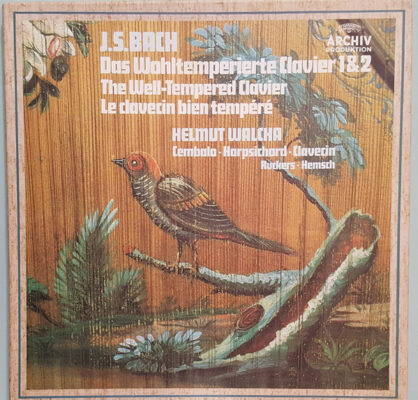
Bach: Well-Tempered Clavier I & II
Helmut Walcha (harpsichord) (Archiv)
(scroll down for English review)
DG推出了管風琴名家Helmut Walcha在Archiv的錄音全集,套裝大部分都是巴哈管風琴作品,包括Walcha分別用單聲道及立體聲錄的兩套巴哈全集。但套裝中仍有一些古鍵琴錄音,包括這套在1973至74年錄的《平均律》。其實Walcha在1961年為德國EMI錄過《平均律》,是一系列巴哈古鍵琴作品錄音之一,華納將之再版成13CD套裝,我聽了一會放棄,因為覺得很悶。
對古鍵琴認識更深後,更理直氣壯覺得不聽是正確的,因為Walcha並非用歷史古鍵琴,或它們的複製品,而是用了現代的「改良」古鍵琴,那種琴以加大古鍵琴音量為前提,卻破壞了古鍵琴原有設計中的發音。
之所以聽這套錄音,是因為見到封面上兩個細字:Ruckers Hemsch。這是兩個人的名字,而且隔了一個世紀。Ruckers是17世紀比利時製琴名家,Hemsch則是18世紀巴黎琴匠。Ruckers造的琴或現代複製品被好些演奏者推崇,Koopman近來在家拍攝的YouTube片中他就彈過一部,但之所以會有Hemsch這個名字,應該就是他把一部單鍵盤的Ruckers,改裝成雙鍵盤。多一個鍵盤不只是加個鍵盤,更要加一整套琴弦,因此連琴身都要改造,總之就令音色美妙的Ruckers琴,變成更能滿足專業演奏者需要的雙鍵盤琴。
Walcha這個錄音其實不像一般人心目中的古鍵琴聲音,聲音一點都不尖,高中低音域能區分到音色,甚至有連鋼琴都彈不出的連奏效果。我覺得和一般古鍵琴相比,此琴發音的「鈎弦」感覺很微,才是令它和一般古鍵琴很不同的主因。
很多古鍵琴名家都是兼擅管風琴(或者反轉),例如Leonhardt、Koopman、鈴木雅明,不過Walcha的管風琴名聲明顯較大,而他這兒的琴音,又真的令我聯想到管風琴。一來是連奏感很強(其實是太強),二來是沒有古鍵琴家都會經營的觸感分別。《平均律》有些作品雖然真的較適合管風琴彈,但用管風琴彈全套《平均律》的人只是極少數,我覺得Walcha可能就真的是用彈管風琴的心態去彈。
不過以娛樂角度去看,這套錄音真的很悶,要用聽《賦格的藝術》的心態去聽,但我不是責難,Walcha這種彈法言之有理,我也乖乖聽完。我回去那套用現代古鍵琴的那套錄音聽了一會,那樂器的牌子是Ammer,不是Karl Richter常用的Neupert,Ammer沒有Neupert那麼浮誇,音色很像鋼琴及管風琴的混合體,然後我就想:Ammer可能比古董琴更適合Walcha,也沒那麼悶……
DG has just released a box set of Helmut Walcha’ s complete Archiv recordings. The set is mainly Bach’s organ works but there are six CDs’ worth of harpsichord recordings. This complete set of Well Tempered Clavier was made in 1973-74, and was Walcha’s second recording of it after recording it for EMI Electrola in 1961. Those EMI Electrola recordings have been reissued as a 13-CD set on Warner. I gave up listening to that as I found it quite boring.
As I got more acquainted with the harpsichord I felt more justified in rejecting those Electrola recordings because they were made on a modern Ammer harpsichord instead of historical instruments or their replicas.
What drew me to this Archiv remake were two names on the cover: Ruckers Hemsch. They were two persons living in different centuries. Ruckers was the famed 17th century Antwerp harpsichord builder, and the reason why Mr. Hemsch came into the picture was that this 18th century Parisian builder probably remodeled a single manual Ruckers harpsichord into a double manual instrument.
This particular instrument sounded quite unlike your typical harpsichord. It was very tender; the attack was significantly mellower than usual harpsichords. And the legato that could make a pianist blush. Perhaps most importantly the action didn’t give the sense of plucking.
It might be a cliché to associate Walcha’s reputation as an organist with his performance of the WTC. But this recording really gave me that impression, thanks to Walcha’s legato (perhaps excessively so) and the unvarying of touch. True, a handful of fugues must have been conceived with the organ in mind, but organists who actually played the whole WTC on the organ were rare. I guess Walcha was probably approaching it as an organ piece.
In terms of entertainment this recording is anything but. I had to sit through it like I did the Art of Fugue. But this wasn’t criticism, Walcha’s approach had a sense in its own, just take it or leave it, and I did finish the whole set. Then I went back to the Warner set, that Ammer harpsichord wasn’t as lavish as the Neupert harpsichord favoured by Karl Richter, and that Ammer was like a hybrid of piano and organ. Then I thought to myself, perhaps the Ammer was more suitable for Walcha than a “correct” instrument; at least it was much less boring on this Ammer…